Friday, April 1, 2011
Newest TTEC Newsletter!
Don't miss the info on all the upcoming opportunities. TTEC Trail Crew, Let's Move! Along the Appalachian Trail, and ATC's upcoming Virginia Journey's Conference - NOT TO MISS! Check it out: http://www.appalachiantrail.org/atf/cf/%7Bb8a229e6-1cdc-41b7-a615-2d5911950e45%7D/TTEC%202011SPRING.PDF


Thursday, March 31, 2011
Green Teacher Webinars
 Upcoming Webinars…
We’re pleased to announce 3 new one-hour webinars this Spring for formal and non-formal youth educators. For details of these and the four previously-announced webinars, see below or visit http://greenteacher.com/webinars. A reminder: these webinars are free of charge. We hope you’ll take advantage of the opportunity to explore these current popular topics in environmental and outdoor learning with us.
We’ll be announcing more webinars soon, so please check our website frequently – OR visit http://list.web.net/lists/listinfo/gt-news and join our listserv to receive email notices of upcoming webinars.
 Tuesday March 22, 2011, 7:30 - 8:30 p.m. EST
Webinar topic: "School Grounds for Healthy Play and Learning – Research and Case Studies of Good Design and Teaching Excellence on School Grounds"
Presenter: Cam Collyer
How might school grounds now have a greater importance in a child’s development than 20 years ago? How far has the school ground movement in North America come in the past 20 years? Cam will share some excellent examples of school ground design from North America and Europe and contrast them. He’ll also share some approaches to teaching on the school ground that are working well and describe the momentum that, in some areas has school districts working in support of schools improving their grounds.
Age appropriateness: K-12
 Wednesday March 30, 2011, 7:30 - 8:30 p.m. EST
Webinar topic: "Plugged In; But Tuned Out: The Need to Reconnect with Nature"
Presenter: Herb Broda
In this age of alluring techno-gadgetry we need to be very cautious about maintaining a balance between indoor and outdoor activity. At a time when children's natural curiosity about the outdoors is eclipsed by the demands of busy schedules and the ever-present glow of video screens, schools and outdoor centers may be the only places where kids are encouraged to interact with nature. Kids need to go outside for both learning and play—indeed there is a need for old-fashioned unstructured play in nature – the kind of invented play that “older” folks fondly recall.
Age appropriateness: K-12
 Thursday April 7, 2011, 7:30 - 8:30 p.m. EST
Webinar topic: "Shades of Green: Developing Artistic Approaches to Environmental Education"
Presenter: Hilary Inwood
This webinar explores the emerging field of eco-art education, an integration of art education and environmental education, as a means of helping to develop environmental literacy in students and teachers. Hilary will introduce artwork and artists focusing on environmental issues in Canada and beyond, as well as some of the eco-art work that has been created in Toronto schools in recent years. Participants will be invited to share their own ideas and projects for creative approaches to EE.
Age appropriateness: K-12
 Tuesday April 12, 2011, 7:30 - 8:30 p.m. EST
Webinar topic: “Innovative Curriculum Design for Sustainability”
Presenter: Jaimie Cloud
Useful to both Pre K-12Educators and non-formal educators of adults and young people, the main idea of the first part is that thinking drives behavior and behavior causes results. Identifying and naming the changes in thinking required to make the shift toward sustainability is critical to the design of transformative education for sustainability (EfS) experiences. Jaimie will present the “big ideas” that frame EfS, and will then walk participants through the EfS curriculum design and innovation process.
Age appropriateness: K-12 (for formal and non-formal educators)
 Monday May 2, 2011, 7:30 - 8:30 p.m. EST
Webinar topic: “Using the Environment as a Context for Learning in Standards-Based Education Systems”
Presenter: Gerry Lieberman
The webinar will discuss the instructional components of the Environment as an Integrating Context (EIC) Model™ that was first developed by the State Education and Environment Roundtable (SEER) in 1998. Describing how these practices can help schools meet the academic needs of their students, it will summarize some of the evidence about the educational efficacy of the EIC Model™. Finally, it will provide an overview of SEER’s recent work in helping schools implement the EIC Model™ and briefly discuss how environmental educators can support schools restructure their programs in order to implement an environment-based education program.
Age appropriateness: K-12
 Tuesday May 10, 2011, 7:30 - 8:30 p.m. EST
Webinar topic: “FROG SONGS: Poetry and Essays, Field Ecology and Entomology”
Presenter: Brian Fox Ellis
A poet’s eye and gift for language is very similar to the detailed observation and ability to communicate complex ideas required of scientists. Learn to use haiku to teach entomology. Learn to use poetry to help students write clearer more exciting essays. This simple set of lesson plans can be used by classroom teachers or informal educators to get students outdoors on a warm spring day to explore the relationships between insects and biodiversity. Come to celebrate the voices of nature and find your voice as a poet.
Age appropriateness: K-12 (for formal and non-formal educators)
 Wednesday May 25, 2011, 7:30 - 8:30 p.m. EST
Webinar topic: “Green Craft-Making”
Presenter: Zabe MacEachren
The why and how of focusing one’s eco-art activities on using natural materials easily found in the outdoors.
Age appropriateness: K-12 (for formal and non-formal educators)
We hope to see you at one of our webinars in the near future!
Sincerely,

Tim Grant, Editor
Monday, January 31, 2011
Sunday, September 26, 2010
Meeting with Mt Rogers Trail Club
Please visit my site at http://www.graysongchs.blogspot.com/ to keep up with the progress we are making as TTEC teachers in Grayson County.
Monday, August 23, 2010


Saturday, August 14, 2010
Friday, August 13, 2010
IN THE HEAT OF THE SUMMER, MEMORIES ARE FORGED
THE JULY 2010 TRAIL TO EVERY CLASSROOM BACKPACKING TRIP
Written by Kimberly Williams, Landscape Protection Coordinator at the Appalachian Trail Conservancy
Threat of severe thunderstorms, humidity so thick you could part it, and a 500’ foot rise in a mile did not deter ten teachers representing multiple schools, communities, and states along the Appalachian National Scenic Trail. These teachers are part of Appalachian Trail Conservancy’s and the National Park Service’s coordinated Trail to Every Classroom (TTEC) Program. Trail to Every Classroom is a professional development program for K-12 teachers. The program promotes conservation, civic participation, and healthy lifestyles by using the Appalachian Trail as an educational resource. TTEC promotes multi-disciplinary / whole school approaches to curriculum development and provides toolkits on everything from grant writing, experiential education, to hike leadership.
At the weeklong summer institute in West Virginia, teachers choose from multiple workshops, and ten signed up for an overnight hike on the Appalachian Trail. For many, this was their first over-night camping trip, their first lugging of a 30 lb. pack all day, and their first jaunt out on the Trail. For all it was a first-hand experience to learn about the culture of the Trail, Leave No Trace Ethics in practice, and a miniature experience of the day in the life of a thru-hiker.
With determination the group prevailed, making it three miles to the top and to Ed Garvey shelter, the first shelter North of Harpers Ferry, West Virginia. As temperatures soared into the 90’s in Mid-July, these teachers bonded as they ascended with laughter, conversations, and inquisitiveness about the Trail and the surrounding environment.
Teachers were broken out into groups, each with an assignment and discoveries to make: preparing meals on gas-powered stoves, hanging bear ropes, the wonders of composting privies, siting and setting up tents, and a half-mile several hundred foot descent to filter water for the entire group. Ridgerunner Faren MacDonald joined the group at the shelter, and answered questions and discussed her experience on the Trail.
One of the teacher’s greatest discoveries was to find a teenage group (led by young adults) on an overnight trip. Being the same age group as their students, the teachers conversed and built a friendship with the younger camping companions. Later into the night it was a picturesque moment as the young teens peeped, listening through the rungs of the loft of the shelter as the teachers told ghost stories; one in particular telling the travails of her hobby as a ghost hunter.
The next day all remarked that the three-mile hike out seemed to be done in no time. There is something about an overnight backpacking trip that can bond a group together. It’s a magical mixture of communally forged memory, of shared sweat and laughter, of sharing tent space, and hearing the wild noises in the dark of night. Whatever the mixture was, it put a smile on this group of ten as they rode back together in the Appalachian Trail Conservancy van. The experience surely imparted a sense of love, respect, and curiosity about the Trail into these teachers and will be passed on to their students.
http://www.flickr.com/photos/atconservancy/sets/72157624463657657/
Subscribe to:
Posts (Atom)
North Carolina NCCAT participants

At the Wayah Bald Fire Tower
Mary Jane
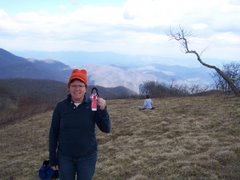
On top of Silers Bald