A fun idea to try out with your students on the Appalachian Trail!
Over the past twenty years, several native ladybugs that were once very common have become extremely rare. Scientists need to have detailed information on which species are still out there and how many individuals are around. Entomologists at Cornell can identify the different species but they need you to be their legs, hands and eyes.
The Lost Ladybug Project asks you to help find out wehre all the ladybugs have gone so we can try to prevent more native species from becoming so rare. This is the ultimate summer science project for kids and adults! You can learn, have fun and help save these important species. Here's how to participate in the research.
1. Collect: Go collect ladybugs! There are many different colors and shapes.
2. Take Note: Time, location, and habitat (for example, wetlands, meadow, garden).
3. Take Their Picture: Take pictures of all you find but please do not kill the insects.
4. Send the Info & Photos: Send this information and the digital images via www.lostladybug.org (click the "Upload Images" tab).
5. Set Them Free: Please release the ladybugs safely where you foud them.
For excellent ladybug identification guides and information, visit: www.lostladybug.org
Enjoy!
Wednesday, September 28, 2011


Southern Workshop Reflections

The TTEC Fall Southern Region Workshop was held September 23-24, 2011, at the Great Smoky Mountains Institute at Tremont. Since no nature lover would miss an opportunity to spend time in our beautiful Smokies, attendance was maximized with all 8 teacher/educators, 3 TTEC alumni, 1 club representative, and, of course, SORO AT rep and coordinator, Julie Judkins. The two days sped by as we learned, hiked, presented, shared, connected, ate and slept.
We met early Friday morning and after stashing our gear at Walker Grove Tent Village, we reconvened in the outdoor Friendship Circle for curriculum sharing. We had an activity with a Park Ranger that involved leaf litter and critters. After lunch we were welcomed by Tiffany Beachy, a Tremont educator, and given a geology overview before we hiked to Spruce Flats Falls. On the hike we did some tree identification which culminated in our watching a black snake climb from a fallen tree trunk to and through smaller trees. It was more exciting than prime time. The falls were great, but we were all wondering if we would see the snake on our return hike and would it fall on our heads!?
After dinner we met again at the Friendship Circle for a night hike. No light sources were permitted. This allowed us to view glow worms and to further test our senses. After going slowly up one trail, feeling our way with our feet and holding hands and/or shoulders, consensus was that we did NOT like night hiking! We also learned we could not identify colors at night and that Wintergreen Life Savers spark when bitten!
After breakfast on our second day, Javier Folgar, AT’s Marketing and Communication Manager, gave us an informative presentation about working with the media. He was able to answer our questions and concerns and had good examples to share. Next, we Skyped with Pat Woods about grad credit projects. We enjoyed a presentation from our 2008 TTEC alumni about their TTEC project. Talk about partnering…they made it real. After lunch we met with folks from the Rocky Top maintaining crew. It was interesting to learn the tools they use and the scope of their work.
Unbeknown to us, while we listened to the Rocky Top crew leaders, our 2008 TTEC alumni—Kate Fisher, Becky LedBetter, and Jan Onan—were preparing the closing ceremony. As we entered the Friendship Circle, we chose a rock to build a cairn because we all build on the work of others. Then we were given a candle to light our candle and pass on to another, sharing the light. Julie Judkins presented the new TTEC graduate their certificates. Everyone shared some closing comments. And, so it was with warmth and friendship we ended our workshop in the Smokies.
Hope to see everyone next July in the Whites! Because what nature lover would miss that?!?
Respectfully Submitted,
Sharon Van Horn
We met early Friday morning and after stashing our gear at Walker Grove Tent Village, we reconvened in the outdoor Friendship Circle for curriculum sharing. We had an activity with a Park Ranger that involved leaf litter and critters. After lunch we were welcomed by Tiffany Beachy, a Tremont educator, and given a geology overview before we hiked to Spruce Flats Falls. On the hike we did some tree identification which culminated in our watching a black snake climb from a fallen tree trunk to and through smaller trees. It was more exciting than prime time. The falls were great, but we were all wondering if we would see the snake on our return hike and would it fall on our heads!?
After dinner we met again at the Friendship Circle for a night hike. No light sources were permitted. This allowed us to view glow worms and to further test our senses. After going slowly up one trail, feeling our way with our feet and holding hands and/or shoulders, consensus was that we did NOT like night hiking! We also learned we could not identify colors at night and that Wintergreen Life Savers spark when bitten!
After breakfast on our second day, Javier Folgar, AT’s Marketing and Communication Manager, gave us an informative presentation about working with the media. He was able to answer our questions and concerns and had good examples to share. Next, we Skyped with Pat Woods about grad credit projects. We enjoyed a presentation from our 2008 TTEC alumni about their TTEC project. Talk about partnering…they made it real. After lunch we met with folks from the Rocky Top maintaining crew. It was interesting to learn the tools they use and the scope of their work.
Unbeknown to us, while we listened to the Rocky Top crew leaders, our 2008 TTEC alumni—Kate Fisher, Becky LedBetter, and Jan Onan—were preparing the closing ceremony. As we entered the Friendship Circle, we chose a rock to build a cairn because we all build on the work of others. Then we were given a candle to light our candle and pass on to another, sharing the light. Julie Judkins presented the new TTEC graduate their certificates. Everyone shared some closing comments. And, so it was with warmth and friendship we ended our workshop in the Smokies.
Hope to see everyone next July in the Whites! Because what nature lover would miss that?!?
Respectfully Submitted,
Sharon Van Horn
Wednesday, August 10, 2011
Reflection on Institute 2011
I thought it worth sharing Tom's email after the recent TTEC institute:
You all have been on my mind and heart since our week together… I wanted to say thanks to all of you for sharing your passion and ideas for wanting to get your students & fellow teachers outside and connected to Nature. As I “reflect” on the week – all of it was special but your presentations were “wicked good” and our closing circle was very meaningful for me. Your energy has given me hope, inspiration and validation in what we all do…to engage our students and other teachers to be aware, appreciate and put into action the importance of our natural resources – especially the Appalachian Trail! This experience at our summer institute has helped me focus on my own Naturalist training this week with my staff – I have used some techniques and reflection exercises with them…thanks.
Here is a link to some research that might help you encourage why we need to do this important work with many areas of concerns you all shared during the week…from other teachers, administrators, & all grants you guys will get…
Just let me know what I can do for you in the future…I will pass on some more resources to help you in the future.
Enjoyed meeting and being with you all (southerners) or you guys (northerners…)
Wicked good time!
Tom
Tom Howick, C.I.G.
Director of Education
Master Naturalist Coordinator
Chattahoochee Nature Center
You all have been on my mind and heart since our week together… I wanted to say thanks to all of you for sharing your passion and ideas for wanting to get your students & fellow teachers outside and connected to Nature. As I “reflect” on the week – all of it was special but your presentations were “wicked good” and our closing circle was very meaningful for me. Your energy has given me hope, inspiration and validation in what we all do…to engage our students and other teachers to be aware, appreciate and put into action the importance of our natural resources – especially the Appalachian Trail! This experience at our summer institute has helped me focus on my own Naturalist training this week with my staff – I have used some techniques and reflection exercises with them…thanks.
Here is a link to some research that might help you encourage why we need to do this important work with many areas of concerns you all shared during the week…from other teachers, administrators, & all grants you guys will get…
Just let me know what I can do for you in the future…I will pass on some more resources to help you in the future.
Enjoyed meeting and being with you all (southerners) or you guys (northerners…)
Wicked good time!
Tom
Tom Howick, C.I.G.
Director of Education
Master Naturalist Coordinator
Chattahoochee Nature Center
Friday, April 1, 2011
Newest TTEC Newsletter!
Don't miss the info on all the upcoming opportunities. TTEC Trail Crew, Let's Move! Along the Appalachian Trail, and ATC's upcoming Virginia Journey's Conference - NOT TO MISS! Check it out: http://www.appalachiantrail.org/atf/cf/%7Bb8a229e6-1cdc-41b7-a615-2d5911950e45%7D/TTEC%202011SPRING.PDF
Thursday, March 31, 2011
Green Teacher Webinars

We’re pleased to announce 3 new one-hour webinars this Spring for formal and non-formal youth educators. For details of these and the four previously-announced webinars, see below or visit http://greenteacher.com/webinars. A reminder: these webinars are free of charge. We hope you’ll take advantage of the opportunity to explore these current popular topics in environmental and outdoor learning with us.
We’ll be announcing more webinars soon, so please check our website frequently – OR visit http://list.web.net/lists/listinfo/gt-news and join our listserv to receive email notices of upcoming webinars.

Webinar topic: "School Grounds for Healthy Play and Learning – Research and Case Studies of Good Design and Teaching Excellence on School Grounds"
Presenter: Cam Collyer
How might school grounds now have a greater importance in a child’s development than 20 years ago? How far has the school ground movement in North America come in the past 20 years? Cam will share some excellent examples of school ground design from North America and Europe and contrast them. He’ll also share some approaches to teaching on the school ground that are working well and describe the momentum that, in some areas has school districts working in support of schools improving their grounds.
Age appropriateness: K-12

Webinar topic: "Plugged In; But Tuned Out: The Need to Reconnect with Nature"
Presenter: Herb Broda
In this age of alluring techno-gadgetry we need to be very cautious about maintaining a balance between indoor and outdoor activity. At a time when children's natural curiosity about the outdoors is eclipsed by the demands of busy schedules and the ever-present glow of video screens, schools and outdoor centers may be the only places where kids are encouraged to interact with nature. Kids need to go outside for both learning and play—indeed there is a need for old-fashioned unstructured play in nature – the kind of invented play that “older” folks fondly recall.
Age appropriateness: K-12

Webinar topic: "Shades of Green: Developing Artistic Approaches to Environmental Education"
Presenter: Hilary Inwood
This webinar explores the emerging field of eco-art education, an integration of art education and environmental education, as a means of helping to develop environmental literacy in students and teachers. Hilary will introduce artwork and artists focusing on environmental issues in Canada and beyond, as well as some of the eco-art work that has been created in Toronto schools in recent years. Participants will be invited to share their own ideas and projects for creative approaches to EE.
Age appropriateness: K-12

Webinar topic: “Innovative Curriculum Design for Sustainability”
Presenter: Jaimie Cloud
Useful to both Pre K-12Educators and non-formal educators of adults and young people, the main idea of the first part is that thinking drives behavior and behavior causes results. Identifying and naming the changes in thinking required to make the shift toward sustainability is critical to the design of transformative education for sustainability (EfS) experiences. Jaimie will present the “big ideas” that frame EfS, and will then walk participants through the EfS curriculum design and innovation process.
Age appropriateness: K-12 (for formal and non-formal educators)

Webinar topic: “Using the Environment as a Context for Learning in Standards-Based Education Systems”
Presenter: Gerry Lieberman
The webinar will discuss the instructional components of the Environment as an Integrating Context (EIC) Model™ that was first developed by the State Education and Environment Roundtable (SEER) in 1998. Describing how these practices can help schools meet the academic needs of their students, it will summarize some of the evidence about the educational efficacy of the EIC Model™. Finally, it will provide an overview of SEER’s recent work in helping schools implement the EIC Model™ and briefly discuss how environmental educators can support schools restructure their programs in order to implement an environment-based education program.
Age appropriateness: K-12

Webinar topic: “FROG SONGS: Poetry and Essays, Field Ecology and Entomology”
Presenter: Brian Fox Ellis
A poet’s eye and gift for language is very similar to the detailed observation and ability to communicate complex ideas required of scientists. Learn to use haiku to teach entomology. Learn to use poetry to help students write clearer more exciting essays. This simple set of lesson plans can be used by classroom teachers or informal educators to get students outdoors on a warm spring day to explore the relationships between insects and biodiversity. Come to celebrate the voices of nature and find your voice as a poet.
Age appropriateness: K-12 (for formal and non-formal educators)

Webinar topic: “Green Craft-Making”
Presenter: Zabe MacEachren
The why and how of focusing one’s eco-art activities on using natural materials easily found in the outdoors.
Age appropriateness: K-12 (for formal and non-formal educators)
We hope to see you at one of our webinars in the near future!
Sincerely,

Tim Grant, Editor
Monday, January 31, 2011
Sunday, September 26, 2010
Meeting with Mt Rogers Trail Club
Please visit my site at http://www.graysongchs.blogspot.com/ to keep up with the progress we are making as TTEC teachers in Grayson County.
Subscribe to:
Posts (Atom)
North Carolina NCCAT participants

At the Wayah Bald Fire Tower
Mary Jane
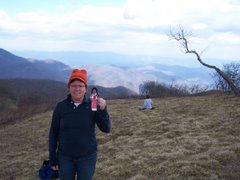
On top of Silers Bald