By Kate Weinman
Fisher, Teacher Librarian at Upward Elementary School, Flat Rock, NC, TTEC Alum
‘08
 |
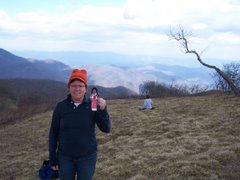
Jan Onan and Kate Fisher at Bear Mountain, Harriman State Park, NY. Photo by Karen Lutz |
I recently moved a 3600 lb. granite boulder 15 feet using a
stick. Really. This is no fish story, although one of my team members tried to
exaggerate. Okay, maybe I need to say that the stick is also called a rock bar. I was working with another educator and our
instructor from Tahawus Trails LLC at the most recent Trails to Every Classroom
Alumni workshop on Bear Mountain in New York State. The focus of the weekend was
Trail Design and Construction and included actual work on the Appalachian Trail. We used simple machine physics – the kind I
can teach my elementary students. This experience is just one of the many that
has shown me the power of TTEC and released the power that I have to make things happen when I join with others.
I first heard of TTEC in 2007 when I was working with kids
to map our school campus. Our counselor
said, “I have something that can help you with that.” She had just returned from NCCAT (North
Carolina Center for the Advancement of Teaching) where the first cohort of TTEC
teachers from the southern region had gathered. At that point, I thought the AT
was something for elite thru- hikers, but I still felt that I wanted to be a
part of the next year’s TTEC group and recruited two teachers who also enjoyed
hiking. We met with Julie Judkins, our
regional ATC representative in Asheville to find out how we could make this
happen.
By April 2008, we had been accepted into the program and met
teachers from Georgia, Tennessee, and North Carolina at Len Foote Hike Inn near
Springer Mountain, GA. We returned with
more energy and ideas than I have had in decades. In no time we helped to
design and implement a Nature Explorers’ Camp for 8-10 year old children based
on Questing
[i].
The camp, held at Bullington Education Center for a week each summer, has
changed slightly but is still going 4 years later.
In July that same year, we met 40 more educators
representing the 14 states linked by the AT. The week-long professional
development featured nationally known experts in the fields of environmental
education and service learning and was fueled by the energy and ideas of
passionate colleagues. My team began work on curriculum for 3rd
grade students, a “Plant Patrol” of invasive non-native plants in our community
and on the AT, less than an hour from our school. When we implemented the curriculum later that
year, students consulted local horticultural experts and focused on the most
troublesome species. They engaged in
three service projects to remove Japanese Knotweed, Chinese Silvergrass and
Autumn Olive at our local horticultural education center and on the AT near Hot
Springs, NC. The trip to Hot Springs and
the brochure the kids designed for our school and community were made possible
by a grant from the ATC. Sixty students
had their first opportunity to walk on the AT, meet a real thru-hiker, and
engage in a meaningful community service project that day. Many of them formed dreams of hiking the AT
and returned to school to write letters to AT hikers which were placed in the
Hot Springs diner. Hikers who read the letters at the diner wrote responses and
4 years later, this notebook is still a favorite read in my school library. One
of the 3rd grade teachers involved moved to a charter school the
next year and has replicated and expanded the project to the point where her
students camp at Hot Springs each year while engaging in community service on
the trail.

Third grade students digging up Autumn Olive roots as part of "Plant
Patrol" service project. Photo by
Jan Onan
Our fall TTEC meeting was at Elmer’s Sunnybrook Inn in Hot
Springs, NC. I suppose it was then that
I fell in love with this tiny trail community and its people. I learned about Benton MacKaye and Myron
Avery, the history of the AT, and experienced the power and satisfaction of
volunteering on the Trail on National Public Lands Day. I also had my first
experience with Trail Magic, something that is impossible for me to explain but
involved bagpipes, the symbolism of a red bridge, and the feeling that I was
part of something magnificent.
3
Kate Fisher and Julie Judkins taking out Japanese Knotweed along the AT near
Hot Springs, NC.
4
Trail Magic appeared at our closing ceremony in Hot Springs, NC as we
contemplated our role in the future of the AT.
To say that these TTEC experiences inspired me is an
understatement. Jen Pharr Davis had just
completed her first record breaking AT supported thru-hike. I contacted her and arranged to have her
visit our school for a whole day and kick off the biggest school event I have
ever organized. That evening, over 300
family members arrived for family night.
We began in the gym where she told about her thru-hike using a slide
presentation. After that, everyone
proceeded out to the foyer to pick up a Trail Diary prepared by our Parent
Involvement Coordinator. This included puzzles, facts, rules of the trail, and questions
about the 6 learning stations spread out along our main hallway. Between them
were brown poster board cylinders marked with white blazes. Families spread out
and rotated through stations that represented each of the 5 AT regions
(Northern New England, Southern New England, Kid-Atlantic, The Virginias, and
our own, the Southern Appalachians).
Julie Judkins, from the Asheville ATC office, supplied the AT Journey magazines
used to create the display boards, a large AT license plate banner, AT tattoos,
and a large Katahdin sign for the last station where students could have their
photo made with Jen Pharr Davis. Our Carolina Mountain Club and local outfitter
Diamond Brand provided displays of books, backpacking equipment, and
volunteers, who were available to talk with students and their families.
5
Families learning about the 5 regions of the AT during Upward Elementary Family
Event
6
AT Family Night display in foyer at Upward Elementary, Flat Rock, NC
7
Jen Pharr Davis gives students the "high 5" after a presentation
about goal setting and her record-breaking hike.
In the month leading up to this event, I worked with PTO and
our entire staff to plan a 21 day AT Read-a-thon where kids earned miles for
minutes read. Each class picked a trail
name and we prepared spreadsheets to record individual student minutes and one
to calculate their class average. As a
part of the TTEC program, I received a 3 x 15 foot map of the AT to hang in my
library. We used the map to teach
geography and to show the reading/hiking progress of each class. Every day,
selected students read about a point of interest during morning
announcements. In all of my K-5th
grade library classes, I taught our Reading, Information & Technology
Standards using information about the AT and the Southern Appalachians. Over 600 students learned about the trail as
we integrated reading, history, science and cultural studies.
They also learned about resources in their local community,
as well as the wider community of outdoor education. Leki donated youth hiking
poles as prizes for the top two readers, and we obtained other support from
individual CMC members, including a visit by one of our trail maintainers. REI
also funded a visit by long distance hiker, Walkin’ Jim, who gave special
performances to the classes and individuals who read the most at the end of the
Read-a-thon.
8
TTEC Team member Jan Onan, Julie Judkins from the ATC Asheville office, and
Walkin' Jim Stolz at our AT Read-a-thon Celebration
Support came from far and wide and we believe the impact was
also far reaching. Our two month focus on the AT was featured in the Henderson
County Public Schools Superintendent’s newsletter that April, reaching the
families of approximately 14,000 students.
Since that time, our TTEC team has been privileged to attend
yearly TTEC workshops as presenters, volunteer at local ATC events, and
continue exploring the AT on and off the trail.
Jan Onan attended the Youth Summit in New Hampshire last summer, and we
both contributed to a resource designed for hiking with families.
9
Kate Weinman Fisher and Jan Onan at the Hot Springs, NC Visitor Center
In this, the 5th year of TTEC, we made new and renewed
connections with educators who have been involved in the last four years. Alumni workshops have helped us discover new
ways to serve our students and communities.
Jan and I attended the spring workshop with Delia Clarke and worked with
other TTEC alumni to design The Guardians
of the Grayson Highlands Quest, an educational treasure hunt through which
visitors learn about the natural history of the park. Then we came back and
worked with Julie Judkins and Jeannette Kendall, a 4th grade teacher
in Hot Springs, NC to design a quest for that Trail Community. This summer we worked with a Teacher/Park
Ranger at the Carl Sandburg National Historic Site right here in Flat Rock to
design another quest for park visitors.
Moving mountains, not quite. . . but I can move something
larger and farther than I ever thought possible and it isn’t just a boulder. My
hope is that I will continue to move and inspire the next generation of hikers,
stewards, and supporters of the AT. This
is the power of TTEC.
[i]
Clarke, Delia and Steven Glazer.
Questing:A
Guide to Creating Community Treasure Hunts. Lebanon, NH: University Press
of New England, 2004.


.JPG)
.JPG)