Friday, June 7, 2013

Invasive Species Awareness Day in Franklin, NC


Post by Mary Bennett

On April 3, 2013, the Land Trust for the Little Tennessee River and the Friends of the Franklin Greenway co-sponsored the Invasive Species Awareness Day along the Greenway Walking Path beside the Little Tennessee River.  Duke Energy provided financial support and Franklin AT Ambassador, Mary Bennett, was contacted as event coordinator. 
Approximately 250 students in grades 5-12,  from 4 educational institutions (Oconaluftee Job Corps, Macon Early College, Franklin High School and Mountain View Intermediate School ) participated in outdoor Invasive Species Awareness Day spring event. 
Invasive Species Awareness Day water quality presentation from WATR – Watershed Association of the Tuckaseegee River.

Interactive Educational Presentation Stations hosted by ten professional conservation organizations, private contractors, from local nonprofits to state and federal government agencies engaged student groups on a wealth of aspects surrounding the of issues invasive species.  Small groups of students (about 8-12 per group) rotated through a series of hands- on learning stations addressing the concerns of invasive species, including plants and animals, identification, history, and management solutions.  Pre-activity information, instructional materials and web links on “Invasives” were provided to teachers in advance of event day.
US Fish & Wildlife rep illustrates clam life cycles to elementary school students
 Each station, presented a topic unique aspect of invasive species ranging from plants, plant pathogens, insects, clams, fish, mammals, soil erosion, water quality, animal adaptations, feral cats and dogs skulls, etc.  Presenters utilized visual aids, natural artifacts, question and answer, guessing activities and scientific observation and analysis to engage students in understanding.

Students study the plant stems of native and non native plants along the Little Tennessee River.

Two additional instructional methods were included during the day: Service Learning and Cross Age Tutoring.  The high school students in Agricultural Education and the Job Corps trainees gained valuable skill development by assisting in the removal of Kudzu near the edge of the Greenway.  Students learned about the tools required for the specific job and cleared the area and followed up with erosion control grass seeding and straw coverage.  These young adults provided a community service to the local community.

The Early College students developed valuable leadership skills by conducting multiple engaging and highly interactive activities for the younger school students.  The students created hands-on learning lessons that allowed every child attending a chance to test knowledge of native versus nonnative species, build a water filter, identify a watershed, a food web and examine bones, branches and shells.  The interaction of teenagers with “tween agers” enriched the experiential learning process.

Monday, June 3, 2013

New England Spring


NERO Team
Post from Lori Innes of Profile High School, Bethlehem NH: “People hike all of those miles? You are crazy!” These are my student’s responses when I share with them that I joined my husband (trail name Bobcat) for 800 miles (my trail name was Sunshine) during his thru-hike on the Appalachian Trail in 2007.  I have a map of the Trail that hangs near my door, and serves as a reminder of our wonderful journey together that ended two weeks before we were married. The map also haunts me because I have wanted to find a way to incorporate this experience into my classroom, but have not had the resources and time to do so until I found out about The Trail to Every Classroom program. After receiving information from my principal, my husband told me that he had spoken to the first TTEC group at the Blackburn Center about his hike. I was on Cloud 9 after being accepted and the first session of the program was inspiring, and I left feeling confident that I would be able to create service learning opportunities in my school.
Here are some highlights:
  • I learned more about soil in an hour than I ever did in any science class.  I didn’t know about different types of soil or that  soil color could be defined.
  • I learned about programs offered by the AMC that I never knew existed and I am excited to build a relationship with this organization. I am a wildflower fanatic and I’ve never incorporated this knowledge into my curriculum.
  • I enjoyed listening to the case studies. They gave me ideas on how to do this in my school. I felt at ease knowing that the TTEC will provide the foundation, and that utilizing the contacts and resources will enable me to implement place based service learning (I also feel fortunate to have a supportive administration).
  • My husband and I had the opportunity to present our lecture about hiking the Appalachian Trail. The hike was an amazing bonding experience that taught us about community, environment and relationships, and we love sharing this experience with others.
The first session tapped into all my passions: hiking, the outdoors and teaching, and left me excited as to what is next (I have so many curriculum ideas now).  I just finished reading Becoming Odyssa (trail name inspired by Odysseus), a memoir by Jennifer Pharr Davis about her 2005 thru-hike on the AT (I’ve been obsessed with AT books lately!) and she writes about becoming comfortable in her own skin because as a thru hiker, people don’t care “what you are but who you are” (Davis). Teenagers face many struggles, one being lack of self confidence. My hope is that exposing students to a place of meaning through literature, hiking or trail maintaining (the Appalachian Trail - which is in our backyard), will boost their esteem and make them feel even more connected to the North Country. They will realize that “place matters” (Robert Siudzinski, session 1 TTEC) and can teach many important lessons about life and self worth. Maybe one day my students will respond to my AT map and say, “I hiked this section” or “I fixed a bridge on the AT” and feel proud and realize that they had a positive impact on the environment and their “backyard” playground on the AT.
Lori and her husband on July 27, 2007
2 weeks before they got married, just after he finished his thru-hike, and she had joined him for 800 miles


Friday, May 3, 2013

MARO Spring TTEC Workshop

Fifteen teachers from five states participated in the 2013 MARO Spring TTEC Workshop held at Kirkridge Retreat Center in Bangor, PA during the first week of April.  The teachers delved into the history of the A.T., placed based service learning, curriculum building and cooperative partnerships before heading into the outdoor classroom of the Trail for a session on Leave No Trace.  Presenters included Karen Lutz and Marian Orlousky of ATC, Dr. Robert Siudzinski of Washington College, Estelle Ruppert of PA DCNR, Dan and Ben Schwartz of AMC-DV and TTEC Alumni Pat Woods, Paul Marth, Bonnie Roth and Shannon Jenkins.  The teachers will head to NCTC in July for the TTEC Summer Institute before returning for the culminating Mid-Atlantic region workshop at the Ironmasters Mansion in Pine Grove Furnace State Park in the fall. 

Monday, April 29, 2013

Monarch Webinar Tonight!

Maryland Science Center logo
Monarch Butterflies and Citizen Science
Michelle-Solensky
Have you ever wondered how the monarchs’ overwintering sites in Mexico were discovered? Learn about this and more in this web seminar about monarchs and citizen science.Register today!

We will begin with a clip of the new IMAX film, “Flight of the Butterflies” and use that as a platform to talk about monarch conservation efforts in the form of four different citizen science projects. Citizen science is the participation of volunteers in research projects led by trained scientists. These projects typically have large ranges, both in terms of geography and time. For example, the National Audubon Society’s Christmas Bird Count began in 1900. Such projects provide vast amounts of data that would not ordinarily be captured by trained scientists alone.

During this web seminar we will discuss four citizen science projects about monarchs at different points in their life cycle. The Monarch Larva Monitoring Project tracks the density of larvae throughout the monarchs’ summer breeding range; Monarch Watch  tags adult butterflies to track their journey to Mexico; Monarch Health  monitors the infection rate of O.e., which is a parasite that infects monarchs; and finally, Journey North  follows the migration of the monarchs and milkweed north in the spring. As you can see, the monarch lends itself to citizen science studies because of its large habitat range and fascinating movement over the course of the year. We will also discuss how you can participate in one or more of these projects with your students, or talk about how you could use the data in your classroom.

Details
Title:
Target grades: K - 12
Dates: Monday, April 29, 2013, 6:30 p.m. – 8:00 p.m. Eastern Time
Note: New users should log in at 6:15 p.m. Eastern time for an introduction to NSTA web seminars.
Presenters: Jim O'Leary and Grant Bowers
Registration
Register today to participate in this web seminar. Upon registering you will receive an e-mail confirmation including information about the program and suggested links to visit in preparation of the event. Additional information about the web seminar will be e-mailed to you days before the program.

Each web seminar is a unique, stand-alone, program. Archives of the Web Seminars and the presenters’ PowerPoint presentations will be available through the links on this web page. Learn more about the features of the Web Seminar and read answers to frequently asked questions from participants.

Saturday, April 20, 2013

Just because school's out for summer doesn't mean learning stops!

Students, their families, and teachers are all invited to attend the 2013 Appalachian Trail Biennial in Cullowhee, N.C. July 19 - 26. 

Please share this opportunity to learn, volunteer, and play on the A.T. with your school. 

Via Facebook
Registration just opened for the Appalachian Trail Biennial in Cullowhee, N.C., July 19-26.  Family friendly activities include hikes, visits to the Cradle of Forestry, Carl Sandburg Home, the Smokies, rafting, and dancing! The registration packet is found at www.appalachiantrail.org/2013biennial.  Use the links on the right to pull up complete information on hikes, workshops, excursions, and evening events.


Via School Newsletter
 or Take-Home Note
Students and parents can keep exploring the Appalachian Trail this summer! Registration just opened for the Appalachian Trail Biennial in Cullowhee, N.C., July 19-26.  Family friendly activities include hikes, visits to the Cradle of Forestry, Carl Sandburg Home, the Smokies, rafting, and dancing! The registration packet is found at www.appalachiantrail.org/2013biennial.  Use the links on the right to pull up complete information on hikes, workshops, excursions, and evening events.

Wednesday, April 17, 2013

FB Groupie

Did y'all (yes, I'm writing from NC so this is allowed) know that there is a TTEC alumni Facebook Group? It is Teachers On Trails.  Join us!

Wednesday, April 3, 2013

Grant Opp.


Project Learning Tree Seeks Applications for Environmental Education Projects

Project Learning Tree is accepting applications from schools and nonprofit organizations for environmental service-learning projects.
Traditional GreenWorks grants of up to $1,000 will be awarded in support of environmental projects that demonstrate service-learning, exemplify student voice, involve at least one community partner, and can be completed within a year. To be eligible, projects must secure at least 50 percent in matching funds (in-kind acceptable).
GreenWork! grants for registered PLT GreenSchools of up to $3,000 support projects that meet all the parameters for traditional GreenWorks grant funding. To be eligible, applicants must be a school (public or private), be registered on the PLT GreenSchoo! Web site, have an established Green Team, have completed one or more of the PLT GreenSchools Investigations, and propose a project based on the findings of one or more of the PLT GreenSchools Investigations.
See the PLT Web site for eligibility and application guidelines.
Primary Subject: Environment
Secondary Subject(s): Education
Geographic Funding Area: National   http://www.plt.org/apply-for-greenworks-environmental-education-grant

North Carolina NCCAT participants

North Carolina NCCAT participants
At the Wayah Bald Fire Tower

Mary Jane

Mary Jane
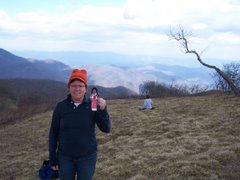
On top of Silers Bald